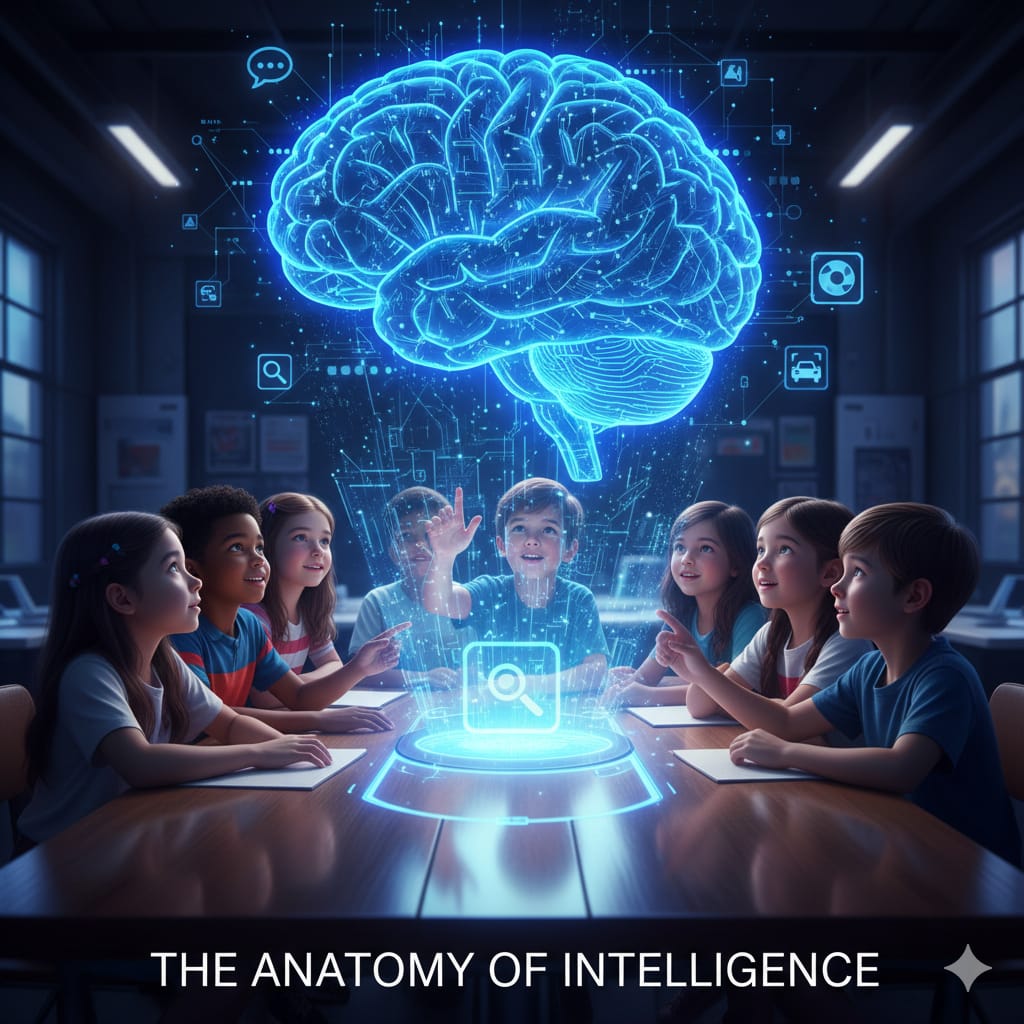
When we talk about Artificial Intelligence (AI) in a school setting, we often start with the “what” before the “how.” Simply put, AI is a field of computer science that builds systems capable of performing tasks that usually require human intelligence. For a student, this might look like a video game character that learns their strategy; for a parent, it looks like a spam filter that knows which emails are junk.
The “professional secret” of AI is that it isn’t actually “smart” in the way a human is. While a human student learns through experience, emotion, and logic, an AI learns through Data. Imagine a massive library where every book is a piece of information. A traditional computer program can only read the books you tell it to read, in the exact order you provide. An AI, however, can scan the entire library, find the patterns between different books, and summarize the hidden connections.
For the 8-16 age group, this is best explained as the “Super-Apprentice.” If you were training a baker, you wouldn’t just give them a recipe; you would show them a thousand loaves of bread. AI works the same way. By processing millions of examples, it learns to predict what the “next right step” should be. This is why AI is so good at translation, image recognition, and even driving cars.
Pro-Tip for Parents: Encourage your child to think of AI as a tool, like a calculator or a microscope. It doesn’t replace their thinking; it extends it.
Discussion Question: * If you could train an AI to do one chore in your house, what data would it need to learn to do it perfectly?